- Layman
- Developer
- ontologist
- Linguist
What is DanNet?
DanNet is the Danish WordNet: a large-scale lexical-semantic resource grouping Danish words into synonym sets (synsets) connected through a rich set of semantic relations. It currently contains ~70K synsets covering ~62K words.
Beyond the standard WordNet relations such as hypernymy, hyponymy, and meronymy, DanNet includes a wide range of relations inherited from the EuroWordNet tradition, such as involved_agent, used_for, has_mero_part, is_caused_by, and domain associations. It was created by the Centre for Language Technology at the University of Copenhagen and Dansk Sprog- og Litteraturselskab, and builds on the EuroWordNet tradition. This new edition was first published in 2023, supported by funding from the Carlsberg Foundation.
What changed in this edition?
This edition (2023–) is a major rewrite. The data has been converted to an RDF-native representation using the Ontolex-lemon standard with GWA relations, around 5000 new senses (mostly adjectives) have been added, and many inconsistencies from the older DanNet have been cleaned up. So-called "supersenses" have been added based on the SemDaX corpora mapping. A detailed list of changes is available on the releases page.
Standards and interoperability
DanNet aligns with the Global WordNet Association interoperability standards and uses the Ontolex-lemon model, making it linkable to Princeton WordNet, the Open English WordNet, and wordnets for other languages via the Collaborative Interlingual Index. It also integrates with Danish resources such as COR (Det Centrale Ordregister) and DDS (Det Danske Sentimentleksikon, a sentiment lexicon). The sense/synset label format is documented separately.
Exploring DanNet
You can browse the resource at wordnet.dk using the search field. Each synset page shows the word's different senses with definitions, usage examples, and a radial diagram visualising the semantic relations emanating from the synset. You can click on any related concept to explore further.
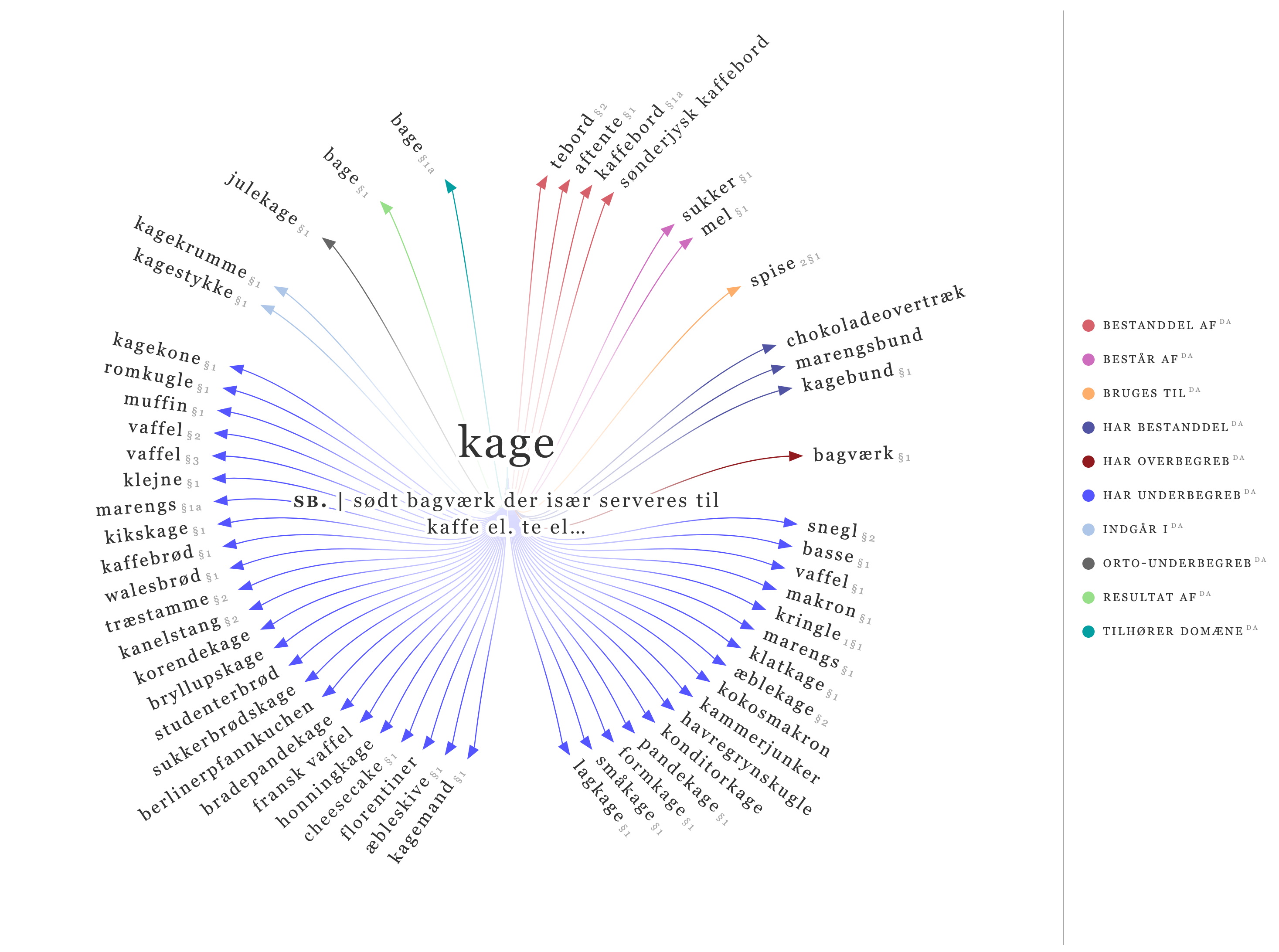
The data is freely available under the CC BY-SA 4.0 license and can be downloaded in RDF/Turtle, CSV, and WN-LMF XML from the downloads page.
Using DanNet in research
- DanNet can be loaded directly via the WN-LMF format into libraries such as Python's wn.
- A public SPARQL endpoint with an interactive query editor is also available for advanced querying. Our guide provides a hands-on introduction for getting started.
- An MCP server enables integration with AI-assisted research workflows.
For citing DanNet and finding related published works, see the university project page.